



Matching Principles of Paint, Hardener and Thinner in Coating Process
A perfect automotive coating finish does not only rely on high-quality paint materials, but also depends heavily on scientific and standardized matching of paint, hardener, and thinner. Many common coating defects, including orange peel, pinholes, slow drying, low hardness, peeling, and foggy surfaces, are not caused by poor paint quality, but by incorrect proportioning and mismatched usage of auxiliary materials. In professional auto refinishing and industrial coating processes, mastering the core matching principles of paint, hardener, and thinner is the key to stable film formation, durable coating performance, and consistent finishing results.
First of all, it is essential to distinguish the functional positioning of each material and follow the basic matching rules for 1K and 2K paint systems. In the automotive coating industry, 1K paints are single-component coatings that cure through solvent volatilization only. They do not require hardener during use and only need to be mixed with a specific proportion of thinner to adjust viscosity for spraying. Adding hardener to 1K paint will destroy the original formula balance, resulting in abnormal drying, surface cracks, and reduced gloss. In contrast, 2K paints are dual-component coatings that must react with hardener to complete chemical curing. Without hardener, the 2K paint will never fully dry, leading to soft film, poor adhesion, and easy scratching.
The matching ratio between paint and hardener determines the fundamental hardness, adhesion, and durability of the coating layer. The chemical cross-linking reaction between paint resin and hardener is the core of forming a dense, high-performance paint film. Excessive hardener will make the coating brittle, causing cracking and peeling after long-term use. Insufficient hardener will lead to incomplete curing, low surface hardness, poor weather resistance, and easy fading. Professional automotive paints are produced with fixed formula ratios, usually 2:1 or 4:1 for paint and hardener. Strictly following the standard proportion ensures stable chemical reaction, uniform film density, and maximum coating durability.
Thinner plays a vital role in adjusting construction fluidity and optimizing spraying effects, and its matching principle is based on construction temperature and spraying environment. Different from hardener, thinner does not participate in the curing reaction. It only dilutes the paint to a suitable viscosity, helping the paint atomize evenly during spraying, spread smoothly on the substrate, and avoid sagging, orange peel and grainy texture. In high-temperature environments, slow-drying thinner is required to prevent too fast volatilization that causes dry spray and rough surfaces. In low-temperature and humid conditions, standard or fast-drying thinner is recommended to avoid moisture trapping and blistering problems.
Material compatibility is another critical matching principle. Not all thinners and hardeners are universal. Different paint systems, including solid color paint, pearl paint, silver paint, and clear coat, correspond to specially formulated supporting auxiliaries. Mixing miscellaneous brand hardeners or low-quality thinners will cause formula conflicts, resulting in poor cross-linking reaction, surface fogging, loss of gloss, and even hidden quality hazards such as poor weather resistance. Using a complete set of matched paint, hardener, and thinner can maximize the performance of the coating system and ensure consistent color, gloss, and hardness.
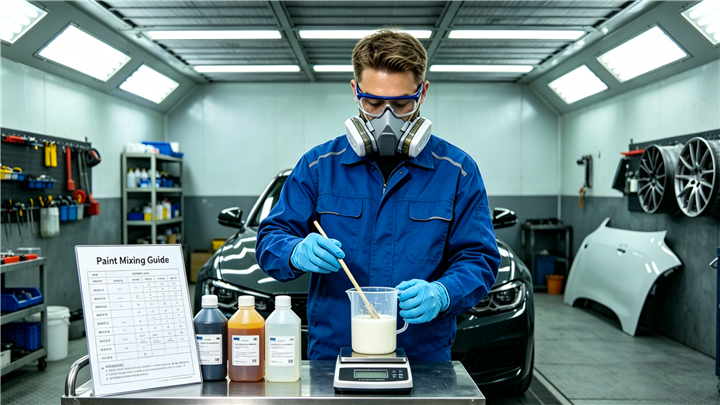
Standardized mixing operation procedures also affect the final coating quality. Professional matching follows the sequence of “paint first, then hardener, and finally thinner”. Workers need to stir the paint evenly before adding hardener for full chemical fusion, and adjust viscosity with thinner after uniform mixing. Random mixing order will lead to uneven component distribution and unstable spraying performance. In addition, the mixed paint has a specific pot life. After mixing paint and hardener, workers must finish spraying within the valid time to avoid material gelatinization and performance failure.
In conclusion, the scientific matching of paint, hardener, and thinner is the core technology of high-quality coating construction. Correct material selection, standard proportioning, and environment-based adjustment can effectively avoid most coating defects, improve finishing smoothness and gloss, and extend the service life of automotive paint surfaces. As a professional automotive coating manufacturer, we provide fully compatible 1K/2K paints, clear coats, hardeners, and thinners with standardized matching ratios, helping global repair shops and coating factories achieve stable, high-grade, and long-lasting coating results.
